Wednesday, May 16, 2012
Risotto Three Ways
I started off by making a monster batch of basic risotto from the ever-reliable Cook with Jamie book. The ingredients are:
- 1 and 3/4 pints vegetable or chicken stock
- 2 tbsp olive oil (something Mr. Oliver can't leave out of anything)
- 1 tbsp butter
- 1 large, finely chopped onion
- 4-5 sticks of celery, also finely chopped
- 1 pound 6 ounces risotto rice (I used medium grain rice and it was fine)
- 9 fluid ounces of vermouth or dry white wine.
The preparation is long but well worth the effort. Basically, you sweat the vegetables, incorporate the rice and slowly add warm stock, letting the rice fully soak it up before you add more. You repeat this till you have something almost very gooey. I say almost because this is a basic recipe in which you will add more deliciousness and liquid.
For anyone whose ever made their own pasta sauce or mixture, risotto is very similar. Just put stuff that works well together and add to the risotto. The only difference with the risotto is that you have to be careful not to add too little or too much liquid or you risk ruining the whole texture which is the whole point of risotto. Because if you don't care about texture, just microwave a bag of instant rice with a can of mushroom soup and stop reading my blog.
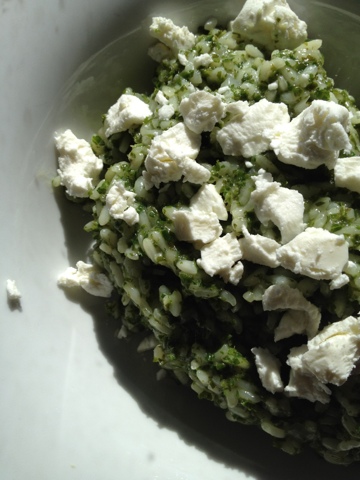
Our first recipe was an adaptation from the same, previously mentioned book. We replaced spinach for kale (it's what we had on hand), chopped and sautéed the kale in some olive oil with garlic. Once cooked down, we popped the vegetables in a food processor till we had a very fine mixture; to this we added a touch of nutmeg. We then finished off half of the basic risotto recipe with 1 and 1/4 pints of vegetable stock, mixed in the kale mixture, added the juice of half a lemon and added cheese: parmesan and goat's cheese for me, daiya for my wife. The great thing about risotto is that it tastes as if you drowned it in cream and butter but is absolutely the healthiest stuff on the planet besides laughing children ;)
Since we still had half the basic risotto recipe left, we decided to make a mushroom risotto. We did the same as above but instead of the kale we put mushrooms, onions, shallots, fresh thyme, garlic, and loads of pepper. I then gave a generous splash of lemon to brighten up what could be something very un-springlike. Topped with a bit of parmesan (or daiya) and olive oil, this dish was quick and easy. Quick because it was made with leftover basic risotto mixture and easy because we'd succeeded once so the odds of failing were much lower.
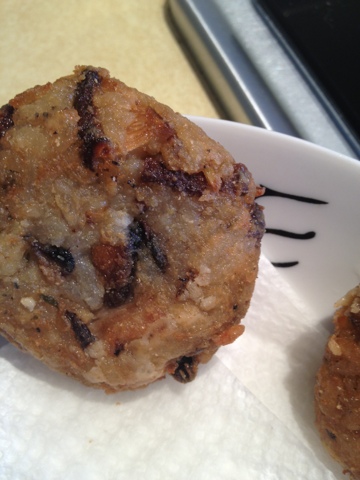
So if you're counting, that's two variations of risotto which build on one basic recipe. Yet here comes something even more beautiful. With the leftover mushroom risotto - this stuff is like the Energizer bunny - we formed patties, rolled in chickpea flour and fried in coconut oil. This was amazing! The smooth, gooey texture of the risotto was given yet more texture with the crunchy outside. To be fair, it would have been better if we'd done some proper breading (i.e. flour, eggs and then the chickpea flour) but we're also avoiding eggs for the moment. We served the mushroom risotto croquettes - cute name, non? - with some beer butt chicken and a simple salad.
To wrap this whole entry up, I'd like to formally state that I love risotto. We're good friends now. Maybe we'll go on a picnic together this summer by the seaside and I'll see if it's as lovely cool as it is warm.
Sunday, October 25, 2009
Jamie's Warm salad of crispy smoked bacon and Jerusalem artichokes
This recipe comes from Cook With Jamie. Once again, the recipes from this book are simple perfection. You can't mess up a Jamie Oliver recipe unless you're incompetent in the kitchen.
The crown jewel of this particular dish, for me, is that the Jerusalem artichokes come from my own garden. I hadn't tasted them yet since I don't often eat potatoes and what I heard about JAs is that you should treat them like potatoes. Maybe so, but they are very different. This recipe called for the JAs to be boiled. Their texture is softer than potatoes; more like rutabaga in that regard. Their taste is delicate, slightly sweet. Kept warm, they went perfectly with the radicchio, Boston lettuce, parsley, cooked smoky bacon from the market and fresh red onions. The vinaigrette is simple: olive oil and balsamic vinegar. I put the vinaigrette in with the bacon and onions, tossed in the JAs, warmed, tossed with the lettuces and served.
Topped with thin slices of parmesan, this was really a delicious salad. We ate it as a meal in itself which can get a bit much if you're not used to the bitterness of radicchio and the richness of the JAs. But it really is a gorgeous salad. Who knew warm salads could be so pleasurable?!
Monday, December 8, 2008
Proper Roast Beef
Growing up, roast beef was some dry crusty grey meat that wasn't even edible even when drenched in gravy. But beef is beef. A roast is no different than a steak. And I don't remember my father eating his beef well well done so I don't know why he treated his roasts that way. Oh well, I know better now.
The inspiration for this traditional meal came from two places: 1) my discovery of an organic beef farmer at the Dieppe Farmer's market who raises his cattle in pastures where they are free to graze and live a chemical free life, and 2) yet another recipe in Jamie Oliver's infinitely useful cookbook, Cook with Jamie. I also took out a meat thermometre, something I don't even think my father knows exists.
Mr. Oliver's recipe calls for roasted beets alongside the beef but seeing as we're past the season of variety at my local farmers markets I made due with root vegetables. I chopped up some ruttabegga, small potatoes, organic carrots (that actually taste like carrots) and the sweetest little onions you've ever tasted. I pressed some of the onions and garlic into the beef, topped these with a handful of thyme sprigs, wrapped the whole thing in bacon, and then slathered it with olive oil and balsamic vinegar. Propping my beef contraption on some carrots - for a roast mustn't boil - I cooked the whole thing, excluding vegetables, for an hour in a 400 degree oven. I then added the vegetables and cooked the whole thing for another hour, making sure to baste the whole thing from time to time. I also stuck the meat thermometre in at this point. I wanted my meat medium well. Not dry.
Once the meat was cooked, I put it in a bowl, covered it in aluminum foil and let it rest for 20 minutes. In the meantime, I drained the juice from the pan, reduced it and kept roasting the vegetables.
Thin slices of beef with sweet roasted vegetables (the onions were the best since I only peeled them and left them whole) and all deliciously swimming in reduced jus. Very good, very well cooked and very different from what my childhood memories.
My girlfriend even said that this was one of the best things I've ever made. Now that's an accomplishment!
Homemade Pasta At Last!!!
Tuesday, November 18, 2008
Jamie Oliver's Amazing Potato and Horseradish Salad
The recipe called for boiling some new potatoes. I don't know what I had exactly, the bag just said mini potatoes...whatever that's supposed to mean. For the sauce, you need the juice of 2 lemons (I used the bottled stuff...major faux pas), the yellow heart of a celery, some chopped fresh parsley (I only had cilantro and a bit of thyme), a few heaping tablespoons of horseradish (I used what was left of the organic root I was given), and 3 heaping tablespoons of crème fraiche or sour cream (I only had the inferior sour cream). Season to taste with sea salt and fresh cracked black pepper. You then had to organize the coated potatoes on some bresaola which is basically cured beef. I had cold deli roast beef which wasn't quality nor cured but was the only thing available in my backwoods area. However, it did the trick. I also didn't bother sprinkling some tarragon leaves over the whole thing but I did pour some cold pressed olive oil over the whole thing which is something Mr. Oliver seems to be unable to go without...he pours olive oil on everything...see http://www.youtube.com/watch?v=Bu90jsp6nkE.
This is undoubtedly the best potato salad ever. If you serve this at a dinner party or bring it along with you at a potluck, you will gain immortal fame amongst your friends and family. When you're dead and gone, they'll say "Do you remember that time Jenny brought that gorgeous potato salad? Wasn't that a wonderful salad!" It's true. That's what they'll be saying.
Sunday, October 5, 2008
Eton Mess
Sunday, September 28, 2008
Roasted Pig's Feet with Wilted Kale and Mashed Veggies
Looking at the fatty pig's feet, I assumed there would be a fair amount of meat on them. They surely smelled delicious as they roasted for 9 hours. This was based on another of Jamie Oliver's recipes from Cook with Jamie. In the "overnight slow-roasted pork", a pork shoulder is called for. It is to be scroed and rubbed with olive oil, sea salt, and fennel seeds. Uncovered in a roasting pan atop halved onions, carrots, garlic and fennel bulbes (which I replaced with potatoes), the pork roasts at 250 degrees for 9 to 12 hours. Fat side up of course.
You then make a sauce by dumping a whole bottle of white wine and a pint of vegetable or chicken stock into the roasting pan for the last 30 minutes of cooking. The result is a very tender and sticky meat along with nicely roasted veggies and a sauce which, once reduced, makes a nice sharp gravy.
I mashed up the veggies and wilted some fresh organic kale to go along with the pork. The kale was nice and bitter, the veggies were rich and chewy, and the pork was tender, sticky and fennely like the recipe promised. The only problem was that there was little to no meat on the bony legs.
I would recommend this preparation for any roast but I would also recommend using a cut with a bit more meat. I mean, if you're going to cook something for 9 hours, it better be plentiful. Oh well, there's always next time. Maybe a leg of lamb. Or a whole duck. Mmmm...
Sunday, September 7, 2008
Jamie's wife's favorite Saturday afternoon pasta
As always, I'm not going to give you his exact recipe but I will tell you what the ingredients are. Basically you've got red onion, red chilli, cinnamon, fresh basil, canned tomatoes (or try fresh, they're in season right now up here in the North Hemisphere), canned tuna in olive oil (I bought some lovely line caught, selective fishing tuna which, fingers crossed, might have less mercury in them), penne, lemon zest, olive oil and the pasta cheese of cheeses parmigiano reggiano. Combine as your cook logic dictates and you should be fine. And maybe not providing amounts is actually a good thing. You're not following some Brit's scientific equation. You're actually going at it for yourself...more or less. Anyways, it's worth trying. Really simple and good.
Wednesday, June 25, 2008
Too Much Lobster
Another thing I found out is that the lobster traps attract more than just the lobster. This being the end of the spring lobster season - the lobster getting "sick" as they say here in order to shed the shells - the traps were mostly empty. Not even enough in them to pay for the fisherman's gas which means that we came back to shore a good 4 hours ahead of schedule. But I did manage to swap a few crabs from the traps before we left. They don't charge for these. They're barely worth anything and they'd have thrown them back in the water anyways so we got a good little treat. And a few hours of taking these apart. You thought lobster was hard to dissect. Try a small crab. Now that's a real pain in the ass.
So true to North American fashion, we ate the majority of our lobster with garlic butter. It's the first time I ate my lobster cold and I think I prefer it this way. When you cook your lobster it tends to get tepid by the time you've started to eat it anyways. So being cold already, you just crack and dip. You don't have to rush. Unless you've got a cooler full of lobster you've got to get through. But I don't think that that's the case for most normal people. Plus our cold lobster had been cooked the same day it was taken out of the water and eaten no more than a few days after that. Fresh is an understatement.
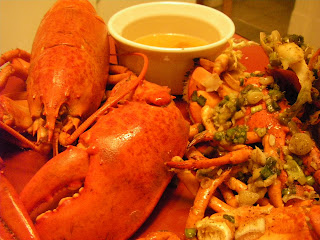
Being a gourmand (or gourmet?) I couldn't be satisfied with eating my lobster just one way. So in the photo above you can see the cold cooked lobster, a ramekin full of fresh garlic butter and a mess of Jamie Oliver's Sticky Finger Lobster taken from Cook with Jamie. This recipe was simply amazing for someone whose never eaten their lobster any other way than whole. The sauce was a mixture of loads of pepper, honey, chopped green onions, garlic, ginger and lemon juice. Though the recipe calls for slicing a live lobster in half and then slathering the different sections with the sauce before baking them in the oven for 12 to 15 minutes till done, I only had cold cooked lobster available. But it worked beautifully anyways. The sauce caramelized and became sticky and delicious. Topped with fresh cilantro and chopped red chilies (or my Thai Hot Sauce which gave it a really delicious flavourful kick) I will certainly eat my lobster like this again. What the hell, eh! When you've got enough lobster to experiment you take the advantage. The results are pure deliciousness.
With the crab, so far, my girlfriend made a crab dip which can be found on almost all apetizer lists in restaurants across Canada. You can find a recipe anywhere on the net but it's basically just a creamy crab dip that I prefer serving with toasted pita slices rather than salty nacho chips. I broiled a good layer of parmesan cheese on top. It makes for a nice apetizer or rich lunch. Loaded with fresh crab meat, you can't go wrong.
I've also got a recipe for crab on toast that's simply dressed with lemon juice and a few other things but that's for another post. Plus that recipe calls for the brown meat inside the shell but cracking a lobster open I wasn't sure what was poop and what was meat. I'll have to go get a course from my local fish monger. I'm not putting anything in my mouth that's brown unless I know for sure that it's meat.
Wednesday, January 23, 2008
Blood Pudding in All Day Breakfast Salad
To tell you the truth, I don't think it was the blood pudding that made this recipe kind of gross. You start off by cooking the blood pudding cut into rings with the bacon. Well the French guy at the market warned me that the blood pudding would come apart and that's the first thing that happened. But then you have to through some stale bread in. Now the recipe doesn't tell you to drain the fat. And it certainly doesn't mention anything about the bits of blood pudding that are floating around in the fat. So when you throw the bread in, all that happens is that a sort of greasy mush forms.
You then have to mix the mush with a handful of yellow endive leaves, an English mustard vinaigrette and top the whole with a poached egg. So I didn't mind the taste of blood pudding. Really. It's more of the grease factor and the fact that everyone I talked to made their ugliest face when I told them I had eaten blood pudding. Supposedly it's best when warmed up with apple slices. I unfortunately didn't have a chance to try this out. The blood pudding appeared in the trash before I could use the rest of it. It's a mystery how that happened. I swear.