I am a first-year teacher. Over the course of the year I have discovered the following. Correct me if I'm wrong.
1) the absolutely most important thing in any school are the kids;
2) each child has his or her own needs, - academic, social, or emotional - all of which must be addressed in different ways for every child;
3) the good teacher doesn't just pay lip-service to caring for children; he or she realizes that sometimes the academics have to take a backseat because the well being of the child comes before anything;
4) the good teacher must balance the multiple demands of the School system with the very real, very every day, very down-to-earth needs of children.
Being a teacher is not limited to pedagogical theories. It's a hands-on, practical art. I care for whole people, not brains on a stick. These little people are the important thing. Everything else - including curriculum, expected practices, demands of principals, etc - is secondary to what the child needs. And, in my opinion, the best person in the school for knowing what a particular child needs is a good, caring teacher.
You can't generalize the needs of people because eventually you're going to have to apply these generalizations to particular people. And it's not going to work. Teaching needs to be adapted constantly. We deal with particular circumstances and particular people. We must have the space and freedom to say "I understand what the theories say, but right now, it's not doing any good for this or these kids".
I am a good teacher because my focus is always the child. I wish I could say the same about the school system.
Saturday, May 26, 2012


Thursday, May 24, 2012
Shakshouka soup with poached eggs
I've been making Shakshouka for a while now. It's basically just a stew of onions, tomatoes, red peppers, and Harissa (a cumin spiced hot sauce). I made my own harissa not too long ago and have since used it to make several batches of shakshouka. Today, on a whim, I decided to blend the whole thing to the consistency of a soup. I also added some hummus. To add a bit of protein, all I have to do is drop in a few eggs and let them poach gently as the soup simmers. A fancy little drizzle of olive oil, a few dashes of paprika and Bob's your uncle, as the British say, whatever that's supposed to mean.
Wednesday, May 23, 2012
Lobster Rolls!!!
As you may know, there are two seasons for lobster: spring and fall. Anyone who knows anything about lobsters will tell you that spring lobster is the best. Their shells are full and they have a sweeter taste. Though the lobsters we found on special at the grocery store isn't nearly as good as the stuff we'll have access to in a few months once we move back to the Maritimes, eating these crimson darlings definitely hit the spot.
Lobster rolls, an East Coast specialty, hell they even serve it at McDonald's over there, are as easy as preparing chicken salad sandwiches. Protein (lobster meat) + mayonnaise (as much as you think necessary) + chopped green onions and celery + salt and pepper + a few leaves of lettuce + good quality bun with its insides grilled as you would do with grilled cheese = lobster roll. Yummers!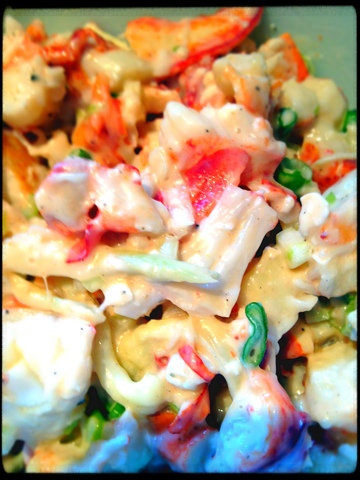
Lobster rolls, an East Coast specialty, hell they even serve it at McDonald's over there, are as easy as preparing chicken salad sandwiches. Protein (lobster meat) + mayonnaise (as much as you think necessary) + chopped green onions and celery + salt and pepper + a few leaves of lettuce + good quality bun with its insides grilled as you would do with grilled cheese = lobster roll. Yummers!
Kale Chips
As you clean up your diet, it gets harder and harder to tolerate junk food. It just makes you feel like crap. One particular junky junk food is chips.
As you can see from the photo, I'm not entirely against chips. However, also notice from the photo that the potato chips are generously topped with a much healthier option: crispy, delicious, green kale chips.
Kale is apparently a super food. As far as nutrition goes, we should all eat more green leaf vegetables. Kale is great as is - in a coleslaw, wilted with onions, in a soup, etc - but they completely transform when tossed in a bit of oil and seasonings and then placed into a 350 degree oven for 10-15 minutes. They go all crispy and delicious. Prepared at home, which, as you can see, is super easy to do, beats the bagged kale chips by a long shot.
As you can see from the photo, I'm not entirely against chips. However, also notice from the photo that the potato chips are generously topped with a much healthier option: crispy, delicious, green kale chips.
Kale is apparently a super food. As far as nutrition goes, we should all eat more green leaf vegetables. Kale is great as is - in a coleslaw, wilted with onions, in a soup, etc - but they completely transform when tossed in a bit of oil and seasonings and then placed into a 350 degree oven for 10-15 minutes. They go all crispy and delicious. Prepared at home, which, as you can see, is super easy to do, beats the bagged kale chips by a long shot.
Sunday, May 20, 2012
Chicken heart burger with sprouted pea pesto, roasted red pepper and Greek yogurt
I love offal. Not only does it have a depth of flavour which muscle meats often lack, it's also super cheap. Most people are turned off by offal but not I. I had a craving for a burger, saw chicken hearts at the store and voila! Chicken heart burgers.
The texture of the patty was more similar to a pate but they still held together nicely (the leftover meat I cooked as a pate so...). The taste was great. The heart has a subtle flavour similar to liver but milder. The condiments also went really well with the meat. Here's the recipe (sorry that I don't have any quantities):
Patties
- Equal quantities of chicken hearts and ground pork
- Good handful of black olives
- Tsp anise seeds
- Tbsp fresh rosemary
- Juine and zest of one lemon
- Salt and pepper
- Dry bread crumbs, about half the amount of the meat
1. Blend all ingredients together in a food processor, form into patties and then gently cook on the barbecue. The mixture is quite crumbly so if you have anything for the grill with smaller holes, use that...just to be safe.
Pea pesto
- 2 cups peas (I had sprouted peas but fresh or frozen peas would do)
- Half cup almonds
- 1 clove of garlic
- 1 cup mint leaves
- Salt
- Olive oil
1. Put all ingredients in a food processor and blitz. Loosen the mixture by slowly pouring in olive oil as it blends. You should end up with a creamy looking, firm mixture. Think pesto.
Serve the patties on fresh, toasted burger buns along with some roasted red and greek yogurt (or sour cream).
The texture of the patty was more similar to a pate but they still held together nicely (the leftover meat I cooked as a pate so...). The taste was great. The heart has a subtle flavour similar to liver but milder. The condiments also went really well with the meat. Here's the recipe (sorry that I don't have any quantities):
Patties
- Equal quantities of chicken hearts and ground pork
- Good handful of black olives
- Tsp anise seeds
- Tbsp fresh rosemary
- Juine and zest of one lemon
- Salt and pepper
- Dry bread crumbs, about half the amount of the meat
1. Blend all ingredients together in a food processor, form into patties and then gently cook on the barbecue. The mixture is quite crumbly so if you have anything for the grill with smaller holes, use that...just to be safe.
Pea pesto
- 2 cups peas (I had sprouted peas but fresh or frozen peas would do)
- Half cup almonds
- 1 clove of garlic
- 1 cup mint leaves
- Salt
- Olive oil
1. Put all ingredients in a food processor and blitz. Loosen the mixture by slowly pouring in olive oil as it blends. You should end up with a creamy looking, firm mixture. Think pesto.
Serve the patties on fresh, toasted burger buns along with some roasted red and greek yogurt (or sour cream).
River Cottage vegan chocolate tart (tastes like cheesecake)
As I mentioned in my post on the chocolate sauce, avocados make everything delicious and creamy without the need for actual cream. My wife is currently reading several books on dairy and gluten free diets. One is called "Go Dairy Free" and talks about all the reasons why limiting or eliminating our dairy consumption is good for anyone, not just those with food allergies. But what's great about these books is that most of us know that animal fats and other stuff like white sugar aren't good for us. However, I know that for my part, making the transition from dairy full food to dairy free food is like learning to cook all over again. When I go through all my cookbooks and look at recipes online, it seems that nearly everything has dairy or gluten. We put cheese on everything and rarely cook with other flours except wheat flour. It's a shame really because since we've been eating differently we've discovered that dairy and gluten free food is not only better for you (something abstract) but actually tastes just as good as the other stuff (something very concrete).
The recipe below is from my favourite show, River Cottage. Apparently, Hugh had a very bad results concerning his cholesterol levels and so he went vegetarian for a whole summer. This is the premise of the show River Cottage Veg. In one episode, he meets some people who cook only raw food; I'm not sure if "to cook" is an appropriate verb in this context. Regardless, the woman in this episode makes a chocolate tart using avocados and coconut oil for the filling; dates and pecans are used for the crust. It's completely dairy and gluten free but absolutely one of the best deserts I've ever had. Though this was something of a revelation, we've found that avocados are often used to give you that creamy texture without any of the cream. So it's cheesecake without the cream cheese. My gut and that part of my conscience which regulates health choices are both making a happy dance.
Below is the link to the whole recipe. Have a go at it and maybe you'll be slightly converted...no better road towards conversion than desert.
http://www.rivercottage.net/recipes/laura-coxeters-raw-chocolate-ganache-tart/
The recipe below is from my favourite show, River Cottage. Apparently, Hugh had a very bad results concerning his cholesterol levels and so he went vegetarian for a whole summer. This is the premise of the show River Cottage Veg. In one episode, he meets some people who cook only raw food; I'm not sure if "to cook" is an appropriate verb in this context. Regardless, the woman in this episode makes a chocolate tart using avocados and coconut oil for the filling; dates and pecans are used for the crust. It's completely dairy and gluten free but absolutely one of the best deserts I've ever had. Though this was something of a revelation, we've found that avocados are often used to give you that creamy texture without any of the cream. So it's cheesecake without the cream cheese. My gut and that part of my conscience which regulates health choices are both making a happy dance.
Below is the link to the whole recipe. Have a go at it and maybe you'll be slightly converted...no better road towards conversion than desert.
http://www.rivercottage.net/recipes/laura-coxeters-raw-chocolate-ganache-tart/
Mango, mint and coconut milk smoothie
It's Sunday morning and summer's finally arrived which means that I don't feel like making a huge, hot, heavy brunch. Smoothies are the perfect solution. They're quick to make and also so versatile that just about anything sweet you have in the fridge can go in.
For this smoothie, I blended a mango, some leftover canary melon, about 20 mint leaves, the juice of a lime and about 1 1/2 cup of coconut milk. Since the mango's so ripe, I didn't need to add any sweetener.
Easy, quick, delicious and dairy free. What more can you want?
For this smoothie, I blended a mango, some leftover canary melon, about 20 mint leaves, the juice of a lime and about 1 1/2 cup of coconut milk. Since the mango's so ripe, I didn't need to add any sweetener.
Easy, quick, delicious and dairy free. What more can you want?
Subscribe to:
Posts (Atom)

